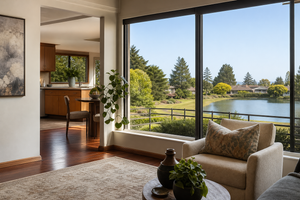
California's New AI Listing Photo Disclosure Law: What East Bay Buyers and Sellers Need to Know
What is California's new AI listing photo disclosure law (AB 723)?
Starting January 1, 2026, California Assembly Bill 723 requires real estate agents to disclose whenever a listing photo has been digitally altered — by editing software or AI — in a way that changes what's actually there, and to show buyers the original, unedited photo. Routine touch-ups like exposure, cropping, and color correction are exempt. Altering the lawn, the walls, the view, or anything visible in the shot is not, and willful violations carry misdemeanor exposure under state real estate licensing law, plus DRE citation fines of up to $2,500.
By Michael Delehanty — Delehanty Group | DRE #01505346 | September 2, 2026
If you've ever clicked into a listing and thought the lawn looked a little too green, or the kitchen looked a little too perfect, you weren't wrong to wonder. One industry study found that roughly 1 in 10 listing photos on major real estate portals show some kind of digital alteration — and more than 90% of those go undisclosed. One buyer, describing AI-cleaned photos in a widely shared story, put it bluntly: it made them stop trusting the listing entirely. As of this year, that reaction isn't just fair — it's the law catching up to it. The listing now has to tell you.
What Actually Counts as "Digitally Altered"
AB 723 adds Section 10140.8 to the California Business and Professions Code, and it's more specific than most people expect. A photo is considered digitally altered if editing software or AI was used to add, remove, or change:
- Furniture, fixtures, or appliances
- Flooring, walls, or paint color
- Landscaping or hardscape
- The façade of the home
- Views through windows
- Streetlights, utility poles, or neighboring properties
What's not covered: adjusting lighting, white balance, exposure, cropping, straightening, or basic color correction — the normal photography edits every listing has had for twenty years. The line the law draws isn't "was this photo edited." It's "does this photo still represent what's actually there."
Our local MLS, Bay East, has already built this into its rules. Any altered photo has to be labeled — "Digitally Altered," "Virtually Staged," or "AI Altered" — and the original has to appear right next to it in the listing. You can't bury the disclosure. It has to sit next to the photo it applies to.
This is exactly the kind of thing my construction background trained me to notice before it became a legal issue. I've walked enough properties to know the difference between a photo that flatters a room and one that flat-out misrepresents it — a foundation crack that's disappeared, a water stain that's been painted out, a yard that was never that green. AB 723 just put a name and a penalty on something a careful buyer's agent should already be catching.
If You're Buying in the East Bay Right Now, Here's What to Watch For
Walnut Creek and the surrounding East Bay are still running a competitive market in the segments that are moving — multiple offers, short windows to decide whether a property is worth touring in person. That pressure is exactly where altered photos do the most damage: you drive out to Danville or Lafayette expecting the kitchen from the listing photos and find something else, and you've lost an evening you didn't have to spare.
A few things to do differently now that the disclosure requirement exists:
- Look for the label. If a photo says "Digitally Altered" or "Virtually Staged," the unedited version should be right there next to it. Compare them before you schedule a showing.
- Ask directly if nothing's labeled. Absence of a label should mean the photos are unedited beyond basic corrections. If something still looks off, ask your agent to confirm before you drive out.
- Treat virtual staging as a layout suggestion, not a room measurement. Virtually staged furniture is still legal and common — it's meant to show scale and function, not to misrepresent size.
If you're touring multiple properties in a compressed window — which is normal right now given how fast well-priced East Bay listings move — a quick photo-versus-reality check before you commit to a showing can save you real time. It's a small habit, but it matters more this year than it used to.
Working with an agent who's actually reviewing listings on your behalf, rather than just sending you a portal link, also helps here — that's part of what a good buyer's agent relationship is supposed to catch before you waste a Saturday.
If You're Listing Your Home, Here's What Changes for You
If you're selling, AB 723 mostly affects your listing photography workflow, not your disclosure paperwork — but it's worth understanding what your agent and photographer need to be doing differently:
- Keep the originals. Every unedited photo needs to be retrievable and displayed alongside any altered version. If your photographer only hands over the polished files, ask for the raw set too.
- Virtual staging still works — it just has to be labeled. If your home is vacant and you want virtually staged photos to help buyers picture furniture placement, that's still allowed. It just needs a clear label like "Virtually Staged."
- Don't let anyone paint out a defect. Removing a visible crack, stain, or repair issue from a photo isn't a marketing choice anymore — it's a disclosure violation on top of whatever your TDS and SPQ already require you to disclose. That's meaningfully different from the thirdhand smoke and other 2026 disclosure updates sellers already have to navigate — this one applies to the marketing, not just the paperwork.
For most sellers in Walnut Creek, Concord, and Pleasant Hill, this doesn't change much day to day — good photographers were already shooting clean, well-lit photos without materially altering the property. But if your photographer or your agent has been touching up more than lighting, this is the year that habit becomes a real compliance risk, not just a style choice.
There's also a strategic upside here: in a market where buyers are more skeptical of photos than they've ever been, listings that are obviously compliant — clearly labeled, originals visible, nothing hidden — build trust faster. That trust translates into more serious showings and fewer buyers who back out after seeing the home in person and feeling misled.
Frequently Asked Questions
Does AB 723 apply to virtual staging?
Yes, but virtual staging is still allowed. It just has to be clearly labeled as "Virtually Staged" so buyers know the furniture shown isn't actually in the home.
What happens if an agent doesn't disclose an altered photo?
Willful violations of AB 723 fall under California's real estate licensing law, which treats them as a misdemeanor. The DRE can also issue citations with fines of up to $2,500 per citation under its Cite and Fine program, and most California MLSs — including Bay East, which covers much of the East Bay — have built the labeling requirement directly into their MLS rules, so an unlabeled altered photo can also trigger a separate MLS compliance violation.
Does basic photo editing like brightening a room count as "digitally altered"?
No. Lighting, white balance, exposure, cropping, straightening, and color correction are specifically exempted, as long as they don't change what the property actually looks like. Standard professional real estate photography still works exactly the way it always has.
Can a seller ask their photographer to remove a defect from a listing photo?
No. Removing a crack, stain, or other visible defect changes the representation of the property, which is exactly what AB 723 requires disclosure for. It also raises separate disclosure concerns under California's TDS and SPQ requirements.
How can a buyer tell if a photo has been altered before touring a home?
Look for a label like "Digitally Altered," "Virtually Staged," or "AI Altered" directly on the photo — the original unedited version should be displayed immediately next to it. If nothing is labeled and something still looks off, ask your agent to check before you schedule a showing.
If you're buying or selling in the East Bay right now and want a second opinion on whether a listing's photos match reality — or want to make sure your own listing is buttoned up before it goes live — I'm happy to walk you through it. Text or email me directly — (510) 697-3900 or michael@delehantyre.com — and we'll talk through the specifics.
About Michael Delehanty — Delehanty Group | DRE #01505346
Michael Delehanty is a Walnut Creek-based real estate agent with Compass, specializing in buying and selling homes across the East Bay — including Walnut Creek, Concord, Pleasant Hill, Danville, Orinda, and the surrounding communities.
Before becoming a real estate agent, Michael spent 15 years running his own contracting firm in the East Bay, working on thousands of homes and major projects across the Bay Area. That hands-on construction background gives his clients a distinct advantage: when Michael walks through a property, he sees what most agents simply can't. From structural details to renovation potential, his experience translates directly into sharper pricing, smarter negotiation, and fewer surprises at the inspection table.
Michael has been a licensed Realtor since 2005, bringing more than 20 years of experience to every transaction. He has successfully guided clients through complex situations including short sales, bank-owned properties, investment transactions, and competitive multiple-offer scenarios. Whether you are a first-time buyer, a move-up seller, or an investor, Michael brings the market knowledge and problem-solving skills to get deals done.
What sets Michael apart is his deep roots in this community. He has lived in Walnut Creek for nearly 30 years and is genuinely invested in the people here — not just the properties. He served four years as Auction Chair and Athletic Boosters President at Las Lomas High School, and has been a member of a local book club for eight years. His two daughters grew up here, attending Las Lomas before going on to the University of Washington and Cal Poly San Luis Obispo. When Michael helps you buy or sell a home in Walnut Creek or the surrounding East Bay communities, he is not just doing a transaction — he is working in the neighborhood where he has built his own life.
michael@delehantyre.com | (510) 697-3900 | michaeldelehanty.com