ARM or 30-Year Fixed? Walnut Creek Buyers at 7% Rates
Should you take an adjustable-rate mortgage or a 30-year fixed in Walnut Creek right now?
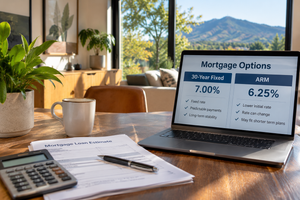
An ARM makes sense if you're confident you'll sell, refinance, or pay down the loan before the fixed period ends, and if you could still afford the payment at the first adjustment cap. With 30-year fixed rates around 7.2% to 7.3% and 5-year ARMs about a point lower, an $800,000 loan saves roughly $530 a month during the fixed years. If you plan to stay ten years or more, or your budget only works at the teaser payment, the 30-year fixed is still the safer choice.
By Michael Delehanty — Delehanty Group | DRE #01505346 | November 11, 2026
More East Bay buyers are asking me this week whether an adjustable-rate mortgage is worth it. The timing isn't random. The MBA reported that ARMs made up 11.4% of mortgage applications in the week ending October 30, the highest share since September 2025, and its chief economist said more borrowers are choosing ARMs "to lower their initial payments."
Then the October inflation report came in hot on November 10. CME FedWatch put the odds of a quarter-point Fed hike at the December 8–9 meeting at about 85%, and fixed rates are expected to drift up with it. If you're house hunting in Walnut Creek, Pleasant Hill, or Concord this fall, you'll likely be asked to pick a loan type before that meeting. Here's how I'd think it through.
What the rate gap actually means for your monthly payment
As of early November, the numbers looked like this:
- 30-year fixed: 7.18% in Freddie Mac's November 5 survey, up from 6.22% a year earlier. The MBA's average for conforming loans was 7.30%, and 7.20% for jumbo balances above $832,750.
- 5/1 ARM: 6.29% in the MBA's survey, with about 1 point paid, almost a full percentage point below the fixed rate.
- ARM loan size: the average ARM application in October was $854,180, nearly double the average purchase loan. That tells you who is choosing them: high-balance borrowers in expensive markets like ours.
Here's what that gap looks like on a typical Walnut Creek purchase. Say you buy a $1,000,000 home with 20% down, for an $800,000 loan. That keeps you just under the 2026 Contra Costa conforming limit of $832,750, which we covered in our post on Walnut Creek jumbo loan limits.
- 30-year fixed at 7.30%: about $5,485 a month in principal and interest
- 5-year ARM at 6.30%: about $4,952 a month
- Difference: about $533 a month, or roughly $32,000 over five years
You also pay down the ARM a little faster, because more of each payment goes to principal. After five years, the ARM balance would be about $747,000, versus about $755,000 on the fixed loan. If you sell or refinance before the first adjustment, the ARM leaves you roughly $40,000 ahead. These are illustrations only. Your rate depends on credit, down payment, points, and the lender.
What happens when the ARM adjusts
This is the part most buyers skim, and it's the part that matters. After the fixed period, your rate resets to a market index, usually SOFR today, plus a margin the lender sets. Most new "5-year" ARMs are actually 5/6 loans, which means the rate adjusts every six months after year five, not once a year.
Caps limit how far the rate can move. The CFPB's ARM handbook explains them as three numbers, like 2/1/5: up to 2 points at the first adjustment, 1 point at each adjustment after that, and 5 points over the life of the loan.
Using the same $800,000 example with a 6.30% start rate and 2/1/5 caps, here's the payment on the remaining balance at the first reset:
- Rate stays at 6.30%: about $4,952 a month (no change)
- Rate resets to 7.30%: about $5,424 a month, close to what the fixed loan would have cost all along
- Rate hits the first cap at 8.30%: about $5,916 a month, roughly $960 more than you were paying
- Rate eventually hits the lifetime cap at 11.30%: about $7,485 a month
Before you sign, ask your lender for the index, the margin, the three cap numbers, and the highest possible payment, in writing. If the worst-case payment would force you to sell, that's your answer.
Who an ARM fits, and who should stay fixed
The question isn't "will rates go down?" Nobody knows, and the Fed is signaling higher in the short term. The real question is how long you'll keep this specific loan.
An ARM can be a smart fit if:
- You have a real exit inside the fixed period. A job relocation, a planned move-up, or a starter condo you expect to outgrow. Choose a 7- or 10-year ARM if you're not sure five years is enough.
- You can afford the payment at the first cap. If $5,916 on that example still fits your budget, the ARM risk is manageable.
- You expect to pay the loan down. Bonuses, RSUs, or proceeds from selling another property can shrink the balance before it adjusts.
- You're buying above the conforming limit. Many Lamorinda and Northgate purchases land in jumbo territory, where lenders often price ARMs aggressively. Industry data cited earlier this year showed nearly half of new mortgages over $1 million were ARMs.
Stay with the 30-year fixed if:
- You plan to stay ten years or more, or this is your forever home.
- The house only works at the ARM payment. That's a sign you're stretching, not saving.
- Your plan depends on refinancing. A refinance requires income, credit, and enough equity at the time, and East Bay condo values have shown they can soften.
- You'd lose sleep over the reset. Peace of mind has a dollar value too.
One middle path: take the fixed loan, then negotiate a seller-paid rate buydown. With sellers outnumbering buyers in many markets this fall, credits are on the table. Our post on what Walnut Creek buyers can negotiate at 7.4% rates walks through concession limits and the math.
How to decide before the December Fed meeting
- Write down how long you'll keep the loan. Be honest about job, family, and move-up plans.
- Get both quotes from the same lender on the same day. Compare a 30-year fixed, a 7-year ARM, and a 10-year ARM with the same points.
- Run the worst case. Ask for the payment at the first cap and the lifetime cap. If you can't cover the first-cap payment, skip the ARM.
- Check that you qualify the safe way. Lenders often qualify 5-year ARMs at a higher rate than the start rate, so pre-approval for a fixed loan doesn't guarantee the ARM amount, or the other way around.
- Time your lock. If you're in contract, look at locking before December 8–9 rather than betting on the Fed. Our earlier post on what the 2026 rate spike means for Walnut Creek buyers covers how fast lenders reprice after a hike.
This is exactly the kind of choice I walk through with buyers before we write an offer, because the loan type changes how much house actually makes sense. If affordability is the bigger worry, our guide to East Bay home affordability in 2026 is a good next read. And I'm not a lender, so always confirm the final terms with yours.
Frequently Asked Questions
Is an ARM a good idea with mortgage rates above 7%?
It can be, if you'll sell, refinance, or pay down the loan before the fixed period ends and can afford the payment at the first adjustment cap. In early November, 5-year ARMs averaged about 6.29% versus about 7.2% to 7.3% for a 30-year fixed, according to the MBA and Freddie Mac. If you plan to stay ten years or more, a fixed rate is usually safer.
How much can an ARM payment go up?
Caps set the limit. On a common 2/1/5 structure, the rate can rise up to 2 points at the first adjustment, 1 point at each later adjustment, and 5 points over the loan's life. On an $800,000 loan starting at 6.30%, hitting the first cap would add roughly $960 a month.
What is a 5/6 ARM?
A 5/6 ARM has a fixed rate for five years, then adjusts every six months based on an index, usually SOFR, plus the lender's margin. It's the most common modern version of what buyers still call a "5/1 ARM."
Can I refinance out of an ARM before it adjusts?
Usually yes, but it isn't guaranteed. You'll need to qualify again on income, credit, and equity at that time, and you'll pay closing costs again. Treat a refinance as a possible bonus, not the plan.
Will a December Fed rate hike raise mortgage rates?
The Fed doesn't set mortgage rates directly, but a hotter-than-expected October inflation report pushed Treasury yields up and markets priced in a likely hike on December 8–9. Mortgage rates tend to move with those expectations, so buyers in contract often lock rather than wait.
The short version: an ARM is a timing tool, not a discount. It pays off when your plans are shorter than the fixed period and your budget can absorb the reset. If you're trying to figure out what this means for your specific situation, I'm happy to walk you through it. Text or email me directly — (510) 697-3900 or michael@delehantyre.com — and we'll talk through the numbers.
About Michael Delehanty — Delehanty Group | DRE #01505346
Michael Delehanty is a Walnut Creek-based real estate agent with Compass, specializing in buying and selling homes across the East Bay — including Walnut Creek, Concord, Pleasant Hill, Danville, Orinda, and the surrounding communities.
Before becoming a real estate agent, Michael spent 15 years running his own contracting firm in the East Bay, working on thousands of homes and major projects across the Bay Area. That hands-on construction background gives his clients a distinct advantage: when Michael walks through a property, he sees what most agents simply can't. From structural details to renovation potential, his experience translates directly into sharper pricing, smarter negotiation, and fewer surprises at the inspection table.
Michael has been a licensed Realtor since 2005, bringing more than 20 years of experience to every transaction. He has successfully guided clients through complex situations including short sales, bank-owned properties, investment transactions, and competitive multiple-offer scenarios. Whether you are a first-time buyer, a move-up seller, or an investor, Michael brings the market knowledge and problem-solving skills to get deals done.
What sets Michael apart is his deep roots in this community. He has lived in Walnut Creek for nearly 30 years and is genuinely invested in the people here — not just the properties. He served four years as Auction Chair and Athletic Boosters President at Las Lomas High School, and has been a member of a local book club for eight years. His two daughters grew up here, attending Las Lomas before going on to the University of Washington and Cal Poly San Luis Obispo. When Michael helps you buy or sell a home in Walnut Creek or the surrounding East Bay communities, he is not just doing a transaction — he is working in the neighborhood where he has built his own life.
michael@delehantyre.com | (510) 697-3900 | michaeldelehanty.com